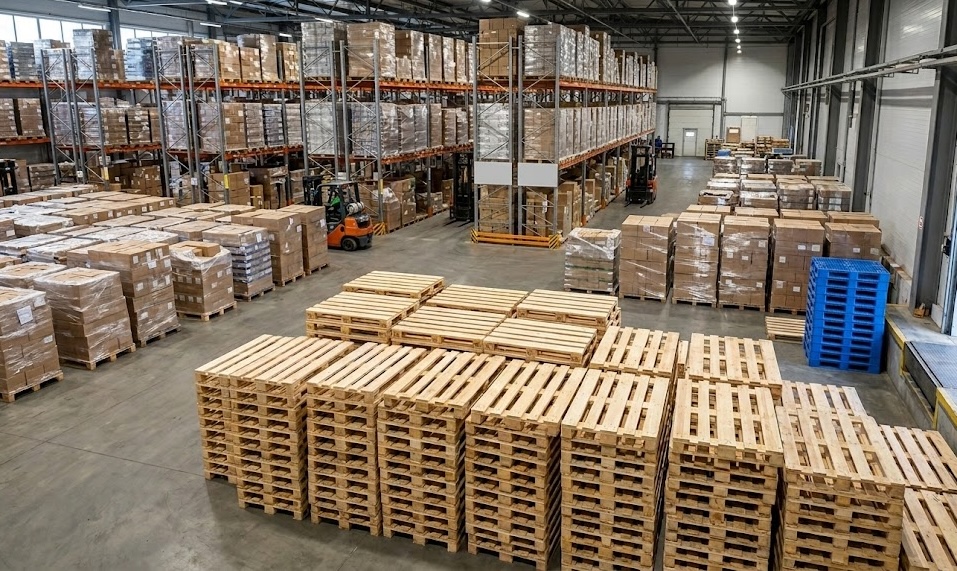
When you order a stack of brand-new wooden pallets, you're paying for more than just lumber and nails. There's a hidden environmental cost embedded in every new pallet — one that most businesses never think about. Let's trace the full lifecycle.
It Starts in the Forest
The U.S. pallet industry consumes roughly 40% of all hardwood lumber produced domestically. That's an enormous amount of forest resources dedicated to a product that many businesses use once and discard. While sustainable forestry practices have improved significantly, the sheer volume of demand puts constant pressure on our forests.
A single standard pallet requires approximately 12 to 15 board feet of lumber. With roughly 500 million new pallets manufactured in the U.S. each year, that's over 6 billion board feet of lumber — enough to build about 300,000 homes.
The Manufacturing Footprint
Raw lumber doesn't become a pallet on its own. The manufacturing process involves:
- Transportation: Logs are trucked from forests to sawmills, then lumber is trucked to pallet manufacturers. Each trip burns diesel fuel.
- Sawmill processing: Converting logs to lumber requires significant energy for sawing, drying, and planing.
- Assembly: While pallet assembly is relatively low-energy, the automated nail guns, conveyors, and plant operations all consume power.
- Treatment: Heat treatment for ISPM 15 compliance requires sustained high temperatures, consuming considerable energy.
The Carbon Math
When you add it all up, a single new wooden pallet carries a carbon footprint of approximately 25 to 35 kg of CO2 equivalent. Multiply that by the millions produced annually, and the industry's carbon impact is substantial.
Now consider that the average pallet makes only 3 to 5 trips in its lifetime before being discarded. That's a lot of environmental investment for relatively few uses.
What Happens at End of Life?
Here's where it gets worse. An estimated 70% of pallets eventually end up in landfills. Wood decomposing in landfills produces methane — a greenhouse gas 80 times more potent than CO2 over a 20-year period. Every pallet in a landfill is not just wasted wood; it's an ongoing source of emissions.
The Used Pallet Alternative
Extending a pallet's life from 3-5 trips to 10-15 trips (through resale, repair, and recycling) dramatically reduces its per-trip environmental cost. A used pallet that makes 10 trips before recycling has roughly one-third the per-trip carbon footprint of a new pallet used 3 times and landfilled.
What You Can Do
- Buy used first: Make used pallets your default choice and only buy new when specific requirements demand it.
- Implement a return program: Recover pallets from your supply chain instead of treating them as disposable.
- Repair before replacing: Fix minor damage instead of scrapping entire pallets.
- Recycle end-of-life pallets: Ensure broken pallets go to a recycler, not a landfill.
- Track your impact: Measure and report the environmental benefits of your sustainable pallet practices.
The choices we make about something as seemingly simple as pallets have real environmental consequences. By choosing used, you're making a tangible difference.