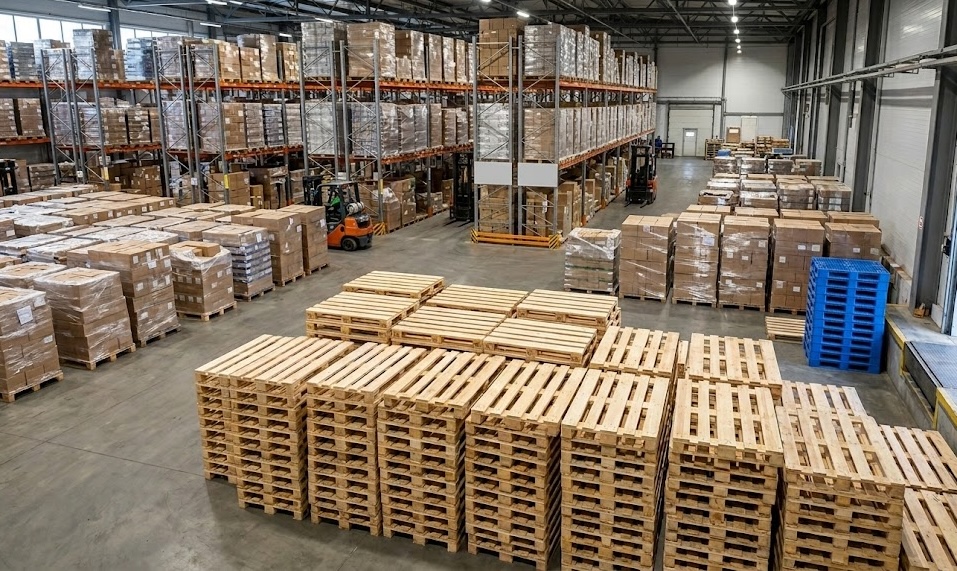
Pallet Recycling
Zero waste. Every damaged or end-of-life pallet is broken down and transformed into valuable materials.
Schedule Pallet Recycling
Have pallets that need recycling? Tell us the quantity and condition, and we will arrange pickup or drop-off.
Zero Pallets to Landfill
Every used pallet that enters our facility leaves as a useful product. We have maintained a zero-landfill policy since day one — and we intend to keep it that way.
95% of all material is recovered and reused or recycled into new products.
Over 500 tons of wood and metal diverted from area landfills each year.
Not a single pallet from our facility has ever gone to a landfill.
Every recycled pallet reduces demand for new timber, saving over 1,200 trees annually.
The Recycling Process
From damaged used pallet to valuable raw material, here is exactly how our recycling process works.
Collection & Receiving
Used pallets arrive at our facility via pickup service, customer drop-off, or partner deliveries. Every pallet is logged and tracked from the moment it enters our yard.
We accept pallets in any condition — broken, moldy, painted, or otherwise. There is no pallet too far gone for our recycling program.
Sorting & Assessment
Each pallet is inspected by our team. Pallets that can be repaired are separated for our repair program. Pallets that are truly end-of-life move to the recycling line.
This triage step is critical. Approximately 40% of pallets that come in for "recycling" actually still have usable life and are diverted to repair instead.
Dismantling
End-of-life pallets are dismantled using specialized equipment. Boards are separated from stringers, blocks are removed, and all hardware (nails, screws, staples) is extracted.
We use a combination of automated pallet dismantlers and hand tools to maximize material recovery and minimize damage to reusable components.
Material Processing
Wood is sorted by type and condition, then processed into its final form: mulch, wood chips, shavings, or fiber. Metal hardware goes to a dedicated metal recycling stream.
Our grinding and chipping equipment produces consistent, high-quality output that meets the specifications required by our downstream partners.
Quality Control
All recycled materials pass through quality control. Wood products are screened for contaminants, sized correctly, and tested for moisture content.
We reject any material that shows signs of chemical treatment, paint contamination, or other issues that could affect the end use of the recycled product.
Distribution
Finished recycled materials are distributed to landscaping companies, farms, manufacturers, power plants, and composting facilities throughout the region.
Our network of buyers for recycled materials ensures that every ounce of material from a decommissioned pallet finds a productive second life.
Where Your Used Pallets End Up
When a used pallet reaches end of life, it does not disappear — it transforms. Here is exactly what happens to the materials.
Landscape Mulch
Pallet wood is ground into high-quality mulch used in landscaping, playgrounds, and garden beds. The wood is screened, cleaned, and often colored for aesthetic applications.
Biomass Fuel
Clean pallet wood chips serve as renewable biomass fuel for industrial boilers and power generation. This displaces fossil fuels and closes the carbon loop.
Animal Bedding
Shredded pallet wood makes excellent animal bedding for equestrian facilities, poultry farms, and livestock operations. It is absorbent, comfortable, and biodegradable.
Particleboard Feedstock
Clean, processed wood fibers from pallets are sold to particleboard manufacturers as raw feedstock, creating new building materials from waste.
Metal Recycling
All nails, screws, staples, and metal hardware are separated and sent to metal recycling facilities. Nothing is wasted in our process.
Compost
Smaller wood particles and sawdust are composted into nutrient-rich soil amendments, completing the natural cycle back to the earth.
Why Pallet Recycling Matters
Pallets account for approximately 10% of all landfill waste in the United States. That is hundreds of millions of pallets discarded every year when they could be recycled into valuable materials.
By recycling your used pallets with Raleigh EcoPallet instead of sending them to a landfill, you are directly contributing to a healthier environment and a more sustainable local economy.
The Problem
The US generates approximately 2 billion pallets per year. Of those, an estimated 300-400 million end up in landfills annually. Each pallet in a landfill takes 3-5 years to decompose, producing methane — a greenhouse gas 80 times more potent than CO2.
Our Solution
Every used pallet that comes through our facility is either repaired and returned to service, or broken down into raw materials that have real market value. We have processed over 50,000 pallets and sent exactly zero to a landfill.
Your Role
By choosing to recycle your used pallets instead of discarding them, you become part of the solution. Many of our clients include their pallet recycling stats in their corporate sustainability reports.
How to Recycle Your Used Pallets
We Pick Up
For 50 or more used pallets in the Raleigh-Durham area, we provide free pickup. Our team loads the truck — your staff does not need to assist. We can schedule recurring pickups for businesses that generate pallets regularly.
- Free for 50+ pallets locally
- Scheduled recurring service
- We handle all loading
You Drop Off
For any quantity, you can drop off used pallets at our facility during business hours. There is no minimum quantity and no drop-off fee. Drive in, unload, and you are done.
- No minimum quantity
- No drop-off fee
- Open Monday - Saturday
What We Accept for Recycling
We accept a wide range of materials for recycling. Understanding what we can and cannot process ensures a smooth recycling experience.
Accepted Materials
Pine, spruce, fir — the most common pallet wood. All conditions accepted.
Oak, maple, birch — accepted in any condition. Higher-value recycling output.
Engineered wood pallets are accepted, though recycling output differs from solid wood.
Loose boards, broken stringers, and wood scraps from pallet manufacturing or repair.
Wooden shipping crates, skids, dunnage, and blocking material are all recyclable.
HT and ISPM-15 stamped pallets are fully recyclable. The heat treatment does not affect our process.
We separate and recycle all metal components. You do not need to remove hardware before recycling.
Contamination Guidelines
Contaminated materials can ruin an entire batch of recycled product. Please ensure the following contaminants are removed or separated before recycling.
Pallets with visible chemical contamination from oils, solvents, or industrial chemicals must be separated. A few drops of motor oil are OK; a soaked pallet is not.
Lumber treated with chromated copper arsenate contains toxic heavy metals and cannot be recycled with standard wood. Look for a greenish tint or CCA stamps.
Pallets stamped with "MB" were treated with a banned fumigant. These cannot enter our recycling stream. Look for ISPM-15 stamps and check for "MB" marking.
Remove shrink wrap, pallet wrap, and plastic strapping before recycling. These materials jam our grinding equipment and contaminate wood output.
Pallets with significant food residue, animal waste, or decomposing organic matter should be cleaned or separated. Mild food staining is acceptable.
Schedule Recurring Recycling Pickups
For businesses that generate pallet waste on a regular basis, our recurring pickup service takes the headache out of waste management. We show up on a predictable schedule, collect your end-of-life pallets, and handle everything from there.
You never have to think about pallet disposal again. No more overflowing pallet yards, no more fire hazards from stored wood, and no more disposal fees from waste haulers.
Weekly Pickup
Best for high-volume operations that generate 100+ end-of-life pallets per week. Our most popular schedule for manufacturing plants and large warehouses.
Biweekly Pickup
Ideal for mid-volume businesses that accumulate pallets steadily. We arrive every two weeks on the same day and time.
Monthly Pickup
Suited for smaller operations or those that generate pallets in slower cycles. Once a month, we clear your yard completely.
On-Call Service
For businesses with unpredictable volume. Call us when your staging area is full, and we will schedule a pickup within 1-2 business days.
Benefits of Recurring Service
Know your recycling costs in advance with fixed scheduling. No surprise disposal invoices.
Receive monthly recycling reports that document your waste diversion for sustainability reporting.
Recurring clients get priority scheduling and guaranteed pickup windows that work around your operation.
Recurring service clients receive preferential pricing compared to one-time recycling requests.
We handle everything — you just make sure the pallets are accessible. No sorting, no prep, no loading on your end.
Upon request, we provide certificates documenting the tonnage recycled and environmental impact of your program.
Your Recycling Impact Per Pickup
Every truckload of pallets you recycle with us creates a measurable positive environmental impact. Here is what a typical pickup of 200 pallets achieves.
Approximately 4,000 pounds of wood saved from decomposing in a landfill and producing methane.
Each truckload of recycled pallets prevents approximately 2.4 tons of CO2-equivalent greenhouse gas emissions.
By recycling pallet wood instead of consuming new timber, each pickup preserves the equivalent of 3 mature trees.
Wood chips from recycled pallets generate approximately 1,200 kilowatt-hours of renewable biomass energy.
Environmental Certificates & Reporting
Many businesses need to document their sustainability efforts for corporate social responsibility reports, ESG disclosures, environmental audits, or LEED certification. We provide the documentation you need to prove your recycling impact.
Our certificates and reports are accepted by auditors and certifying bodies. They include specific data on tonnage recycled, materials recovered, landfill diversion rates, and estimated environmental benefit.
Recycling Certificate
An official certificate documenting the total tonnage of pallet materials recycled through our facility on your behalf. Issued annually or upon request.
Landfill Diversion Report
A detailed report showing the total weight of materials diverted from landfill, with a breakdown by material type (wood, metal, other).
Carbon Offset Summary
An estimated CO2-equivalent savings calculation based on the volume of pallets recycled versus landfilled. Suitable for corporate sustainability reports.
Material Chain-of-Custody
Documentation tracing the lifecycle of your recycled pallets from collection through processing to their final second-life use as mulch, fuel, or feedstock.
Pallet Recycling FAQ
For most standard volumes (50+ pallets) within the Raleigh-Durham metro area, recycling pickup is free. For smaller quantities, there may be a nominal pickup fee, or you can drop off at our facility at no cost. We never charge a disposal or tipping fee — unlike general waste haulers. In some cases, particularly with large volumes of good-condition pallets mixed in, we may actually pay you for the load.
All metal components — nails, screws, staples, brackets, and corner protectors — are separated from the wood during the dismantling process using magnets and manual sorting. The extracted metal is collected and sent to a dedicated metal recycling facility where it is melted down and repurposed into new metal products. Nothing goes to waste.
Yes, in most cases. Pallets with standard latex or water-based paint are fully recyclable. However, pallets coated with lead-based paint (common in older industrial settings) or pallets that have absorbed industrial chemicals require special handling. If you are unsure, we can test a sample during our assessment. Standard warehouse and factory pallets with logos, color coding, or lane markings are always accepted.
When pallets go to a landfill, the wood decomposes anaerobically and produces methane — a potent greenhouse gas. The nails and metal rust and leach into soil and groundwater. The useful fiber and energy in the wood is completely wasted. When pallets are recycled, the wood becomes mulch, biomass fuel, animal bedding, or feedstock for new products. The metal is recovered and reused. Zero waste enters the landfill, and the environmental impact is dramatically reduced.
Absolutely. We provide detailed recycling certificates, landfill diversion reports, carbon offset summaries, and material chain-of-custody documentation. These documents are formatted for inclusion in corporate sustainability reports, ESG disclosures, and LEED certification applications. Many of our clients feature their pallet recycling data prominently in their annual environmental reports.
Yes. We accept plastic pallets for recycling alongside wood pallets. Plastic pallets are processed separately — they are shredded, cleaned, and the plastic resin is sold to manufacturers for use in new products including new plastic pallets, plastic lumber, and industrial containers. HDPE and PP plastic pallets have particularly high recycling value.
Give Your Used Pallets a Second Life
Every pallet you recycle with us is diverted from a landfill and transformed into something useful. Start recycling today.